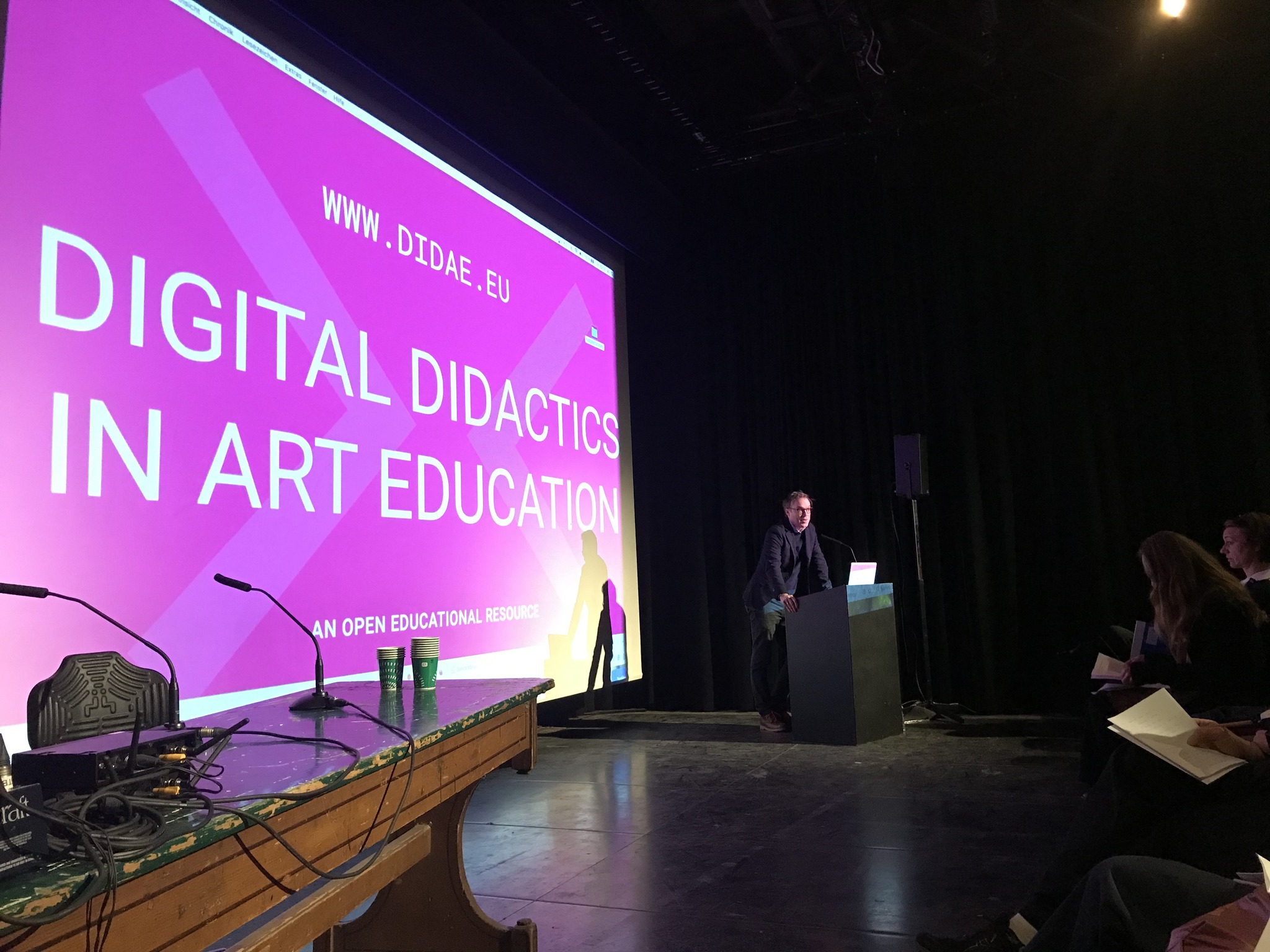
DIGITAL DIDACTICS IN ART EDUCATION

DIGITAL DIDACTICS IN ART EDUCATION Konferenz
27.1.2023, 10–16h
Akademie der bildenden Künste in Wien, Lehárgasse 6–8, 1060 Wien
Die globale Covid-19-Pandemie hat nicht nur zu neuen Formen des Online-Unterrichts und zu Distanz Versammlungen und -Vorträgen geführt, sondern auch den Bedarf an einfach zu verwendenden digitalen Werkzeugen für künstlerische Praxis und Lehre erhöht. Gleichzeitig hat der globale Vorstoß in Richtung Digitalität in der Bildung das Bewusstsein für Fragen der digitalen Ungerechtigkeit geschärft.
Vor dem Hintergrund dieser tiefgreifenden digitalen Transformationsprozesse initiierte die Akademie der bildenden Künste Wien 2020 ein zweijähriges EU-Projekt zu Digital Didactics in Art Education, DIDAE. Das Projekt wird von Elke Krasny an der Akademie der bildenden Künste Wien geleitet, mit Partneruniversitäten in Bern, Budapest, Köln und Rotterdam
Die Konferenz Digital Didactics in Art Education markiert den Abschluss dieses EU-Projekts mit dem Launch der DIDAE-Datenbank, einer offenen Bildungsressource mit leicht zugänglichen digitalen Werkzeugen und Ideen für den Kunstunterricht.
Die indigene Cyberfeministin und Künstlerin Tiara Roxanne wird den Hauptvortrag halten, in dem sie koloniale Strukturen hinterfragt, die in maschinelle Lernsysteme eingebettet sind. Vorträge von Forschenden und Lehrenden von der Akademie der bildenden Künste Wien, der Hochschule der Künste Bern, der Moholy-Nagy-Universität für Kunst und Design in Budapest, der Universität Köln und der Willem de Kooning Academy in Rotterdam.
Program:
Digital Didactics in Art Education, Introduction,
Elke Krasny, Academy of Fine Arts Vienna
The introduction to the one-day conference Digital Didactics in Art Education provides a reflection on the implications of tools and gives an overview of the day’s program. Tools, including digital tools, enable articulating imaginaries and making things. Tools make possible and define relations and connections to others. Tools are always part of the production and reproduction of political and economic relations of power. In art-making and art education there remains a practical need for tools. The research project and platform Digital Didactics in Art Education is a response to the practical need for tools. Working on the open educational resource Digital Didactics in Art Education has raised awareness that there is a need for critical and emancipatory digital humanities engaging with how digital tools that are used in art-making and art eduction are implicated in policy frameworks, such as the European Union’s Digital Education Action Plan, digital capitalism, old-new forms of social and ecological injustices, and the new digital divide.
Elke Krasny is Professor for Art and Education at the Academy of Fine Arts Vienna. She is a feminist cultural theorist, curator, and author. Her scholarship addresses ecological and social justice at the global present with a focus on caring practices in architecture, urbanism, and contemporary art. With Angelika Fitz, she edited Critical Care. Architecture and Urbanism for a Broken Planet (MIT Press, 2019). With Sophie Lingg, Lena Fritsch, Birgit Bosold, and Vera Hofmann, she edited Radicalizing Care. Feminist and Queer Activism in Curating (Sternberg Press, 2021). With Lara Perry she edited Curating as Feminist Organizing (Routledge, 2022). Her forthcoming book Living with an Infected Planet. Covid-19 Feminism and the Global Frontline of Care (transcript 2023) develops a feminist perspective on the rhetoric of war and the realities of care in pandemic times.
On Data Colonialism, Keynote Lecture
Tiara Roxanne, Berlin
In this lecture, Indigenous cyberfeminist and artist Tiara Roxanne will discuss settler colonialism and data colonialism, interrogating colonial structures embedded within machine learning systems. Western Indigenous cultures have been colonized, dehumanized and silenced. As dependency on digitality grows culturally, socially and institutionally, it is crucial to highlight how settler colonialism is embedded in techno-culture (the way in which we socialize, intimize and learn eg) not only to re-assert Indigenous voices into these paradigms, but to think, imagine and navigate through these modes together.
Tiara Roxanne is a Postdoctoral Fellow at Data & Society in NYC. They are a Tarascan Mestiza scholar and artist based in Berlin. Their research and artistic practice investigates the encounter between Indigeneity and AI by interrogating colonial structures embedded within machine learning systems. We must establish decolonial gestures, a concept developed in their dissertation, ”Recovering Indigeneity: Territorial Dehiscence and Digital Immanence”, which was completed under the supervision of Catherine Malabou. In this way, decolonial gestures stand in as forces and modes of decolonial or anti-colonial embodied actions.
Finding Tools, Working on Ideas
Sophie Lingg, Helena Schmidt, Franziska Thurner, Academy of Fine Arts Vienna
The lecture “Finding Tools, Working on Ideas” by Sophie Lingg, Helena Schmidt and Franziska Thurner introduces the concept of Open Educational Resources (OER) as the basis for the Erasmus+ Digital Didactics in Art Education (DIDAE) project and its platform. OER are “teaching, learning, and research resources that reside in the public domain or have been released under an intellectual property license that permits sharing, accessing, repurposing—including for commercial purposes—and collaborating with others.” (UNESCO) We start from the questions of digital justice, knowledge sharing and open resources, based on shortcomings in the current field of education that have been made evident by the pandemic and since then have taken on a whole new dimension. The presentation provides insights into the criteria for the selection of the project’s DIDAE TOOLS (Selection and Classification of Digital Tools) and DIDAE IDEAS (Classroom Assignments) collected on the platform. The best-practice digital TOOLS (websites, apps and software) and connected work assignments represent a radically new approach to critical, emancipatory, intersectional, contemporary post-pandemic didactics of digitality in art education in relation to local and international educational policies.
Sophie Lingg experiments with and researches digitality, digital mass media (Memes, as well as Instagram, YouTube, Maps) and their use for artistic work and art education. Since 2019 Sophie teaches at the Academy of Fine Arts Vienna, at the Art and Education program. Currently she is a PhD student researching artistic and artivist work on social media under the supervision of Elke Krasny. She co-edited Radicalizing Care: Feminist and Queer Activism in Curating together with Elke Krasny, Lena Fritsch, Birgit Bosold and Vera Hofmann (Sternberg Press, 2021).
Franziska Thurner is a media artist and Senior Lecturer at the Academy of Fine Arts Vienna and the University of Art and Design Linz. For the last ten years she has been exploring digital tools for artists and current issues of digital ethics and justice. She focuses on researching and testing new technologies and their usability for art and education (https://katzekatzekatze.at). She collaborates with Hanna Priemetzhofer since 2005 under the name System Jaquelinde, particularly in the fields of video, multimedia installation and augmented reality (https://system-jaquelinde.com).
Helena Schmidt is an art scholar and art mediator in theory and practice. She teaches at the Academy of Fine Arts in Vienna, where she completed her doctorate on the image concept of so-called “poor images” (according to Hito Steyerl) under the supervision of Elke Krasny. She also teaches and mentors at the Bern University of the Arts, where she was an assistant until 2019. Since 2020 she is co-head of mediation at Vienna Design Week. Main fields of interest: Digital imagery, critical art, and design education, poor image art education (https://helenaschmidt.com).
New Digital Methodologies for Art Teaching
Thomas Fogarasy, Kinga German, Moholy-Nagy University of Art and Design Budapest
This lecture addresses the specific challenges of remote art teaching as they were faced by art educators in schools across Hungary during lockdown conditions. Multiple pressures, including time and lack of resources, proved to be most challenging to pedagogical aims and art-making during the pandemic. We share how we approached new digital methodologies and testing strategies as ways of learning with creative assignments through exchanges and in collaboration with the DIDAE project.
Thomas Fogarasy is Head of Programme for Interaction Design MA at Moholy-Nagy University of Art and Design Budapest and Managing Partner of Exalt Interactive, a digital product, and service design firm, where he leads a team of 28 designers. He is the co-founder of DOERS, an international design conference, and the local chapter lead of the Interaction Design Association. Thomas has been a passionate design educator since 2013 and believes that design enables a mindset for positive change in any domain it is introduced to.
Kinga German is an art historian and curator. She is Associate Professor at the Moholy-Nagy University of Art and Design Budapest. Born in Cluj (Romania), she studied art history, pedagogy, and architectural history at the universities of Heidelberg and Karlsruhe. She received her Ph.D. from Stuttgart University. Kinga founded the first and only Hungarian Museum Management postgraduate training. In 2015, she curatated of the exhibition “Sustainable Identities” at the Hungarian Pavilion, la Biennale Arte di Venezia.
Building an Online Platform for Art Education in Post-Internet and Pandemic Times
Manuel Zahn, University of Cologne
The talk will present the design and function of the online platform Digital Didactics in Art Education, highlighting both the criteria-driven development of the database structure and the decisions underlying the interface design. The DIDAE platform will also be reflected upon against the backdrop of post-internet art education, which has gained enormous importance and urgency through the global experience of the Corona pandemic.
Manuel Zahn is Professor of Aesthetic Education at the University of Cologne. His fields of work include philosophy of education, media education, especially film education, art education and aesthetic education in digital and global transformation dynamics as well as postcolonial theory (https://kunst.uni-koeln.de/zahn/).
Beginning with the Body
Michelle Teran, Willem de Kooning Academy in Rotterdam
Social Practices is a socially engaged art and design practice of working with social relations, collaboration, and embodiment. Put another way, it can start with how the body senses and makes sense of its environs, while speaking about the ethics and relationality of place, and how we are all intermeshed in the material world. Yet, how can one develop these social and bodily art practices when suddenly most interactions move to a digital environment? In this lecture, I will speak about some of the challenges social practitioners face – artists, designers, and educators – introducing some creative strategies developed by teachers at the Willem de Kooning Academy during the pandemic lockdown. Performance art, movement and score-based practices, locative media, networked performance, and mail art inform these examples.
Michelle Teran (born in Canada) is an educator, artist, and researcher.
She is a practice-oriented Research Professor of Social Practices at Willem
de Kooning Academy (WdKA). Her research areas encompass socially
engaged and site-specific art, counter-cartographies, social movements,
feminist and critical pedagogy. She received her Philosophiae doctor (Ph.D.) in Artistic Research, Faculty of Fine Art, Music and Design, University of Bergen. Winner of several awards, she received the Transmediale Award, the Turku2011 Digital Media + Art Grand Prix Award, Prix Ars Electronica honorary mention, and the Vida 8.0 Art + Artificial Life International Competition.
The conference is moderated by Elke Krasny, Academy of Fine Arts Vienna, and Maren Polte, Bern University of the Arts
Maren Polte is head of both BA and MA studies in Art Education at the Bern University of the Arts. She is a trained art historian (Ph.D.). She teaches and researches with a focus on contemporary art and photography.